Bunsen burner
00.34
 A Bunsen burner, named after Robert Bunsen, is a common piece of laboratory equipment that produces a single open gas flame, which is used for heating, sterilization, and combustion.
History
When the University of Heidelberg hired Robert Bunsen in 1852, the authorities promised to build him a new laboratory building. Heidelberg had just begun to install coal-gas street lighting, so the new laboratory building was also supplied with illuminating gas. Illumination was one thing; a source of heat for chemical operations something quite different. Previous laboratory lamps left much to be desired regarding economy and simplicity, as well as the quality of the flame for a burner lamp, for it was desirable to maximize the temperature and minimize the luminosity. While his building was still under construction late in 1854, Bunsen suggested certain design principles to the university’s talented mechanic, Peter Desaga, and asked him to construct a prototype. (Similar principles had been used in an earlier burner design by Michael Faraday as well as in a device patented in 1856 by the gas engineer R W Elsner.) The Bunsen/Desaga design succeeded in generating a hot, sootless, non-luminous flame by mixing the gas with air in a controlled fashion before combustion. Desaga created slits for air at the bottom of the cylindrical burner, the flame igniting at the top. By the time the building opened early in 1855, Desaga had made fifty of the burners for Bunsen's students. Bunsen published a description two years later, and many of his colleagues soon adopted the design. Bunsen burners are now used in laboratories all around the world.

Operation
The device in use today safely burns a continuous stream of a flammable gas such as natural gas (which is principally methane) or a liquefied petroleum gas such as propane, butane, or a mixture of both.
The hose barb is connected to a gas nozzle on the lab bench with rubber tubing. Most lab benches are equipped with multiple gas nozzles connected to a central gas source, as well as vacuum, nitrogen, and steam nozzles. The gas then flows up through the base through a small hole at the bottom of the barrel and is directed upward. There are open slots in the side of the tube bottom to admit air into the stream via the Venturi effect, and the gas burns at the top of the tube once ignited by a flame or spark. The most common methods of lighting the burner are using a match or a spark lighter.
The amount of air (or rather oxygen) mixed with the gas stream affects the completeness of the combustion reaction. Less air yields an incomplete and thus cooler reaction, while a gas stream well mixed with air provides oxygen in an equimolar amount and thus a complete and hotter reaction. The air flow can be controlled by opening or closing the slot openings at the base of the barrel, similar in function to the choke in a car's carburetor.
If the collar at the bottom of the tube is adjusted so more air can mix with the gas before combustion, the flame will burn hotter, appearing blue as a result. If the holes are closed, the gas will only mix with ambient air at the point of combustion, that is, only after it has exited the tube at the top. This reduced mixing produces an incomplete reaction, producing a cooler but brighter yellow which is often called the "safety flame" or "luminous flame". The yellow flame is luminous due to small soot particles in the flame which are heated to incandescence. The yellow flame is considered "dirty" because it leaves a layer of carbon on whatever it is heating. When the burner is regulated to produce a hot, blue flame it can be nearly invisible against some backgrounds. The hottest part of the flame is the tip of the inner flame, while the coolest is the whole inner flame. Increasing the amount of fuel gas flow through the tube by opening the needle valve will of course increase the size of the flame. However, unless the airflow is adjusted as well, the flame temperature will decrease because an increased amount of gas is now mixed with the same amount of air, starving the flame of oxygen. The blue flame in a Bunsen burner is hotter than the yellow flame. The hottest part of the blue flame is just above the unburnt gas. The hottest part of the yellow flame is the chimney.
The burner will often be placed on a suitable heatproof mat to protect the lab bench surface.
Burette
00.34
 A burette (also buret) is a vertical cylindrical piece of laboratory glassware with a volumetric graduation on its full length and a precision tap, or stopcock, on the bottom. It is used to dispense known amounts of a liquid reagent in experiments for which such precision is necessary, such as a titration experiment. Burettes are extremely accurate - a 50 cm3 burette has a tolerance of 0.1 cm3 (class B) or 0.06 cm3 (class A).
 Burettes measure from the top since they are used to measure liquids dispensed out the bottom. The difference between starting and final volume is the amount dispensed
Büchner funnel
00.10
 A Büchner funnel is a piece of laboratory equipment used in suction filtration.[1] It is traditionally made of porcelain, but glass and plastic funnels are also available. On top of the funnel-shaped part there is a cylinder with a perforated plate separating it from the funnel. The Hirsch funnel has a similar design; it is used similarly, but for smaller quantities of material. The main difference is that the plate is much smaller, while the walls of the funnel angle outward instead of being vertical. The filtration material, usually filter paper, is placed on the plate, and the filter paper is moistened with a solvent to prevent initial leakage. The liquid to be filtered is poured into the cylinder and drawn through the perforated plate by vacuum
suction.
The main advantage in using this type of filtration is that it proceeds much more quickly (several orders of magnitude) than simply allowing the solvent to drain through the filter medium via the force of gravity. It is essential that the amount of solvent being used be limited to less than what would overflow the flask, otherwise the solvent will be drawn into the vacuum equipment. If the vacuum is provided by a water flow device, an overflow of the solvent could result in the spilling of a hazardous solvent into the wastewater stream, a potential violation of the law, depending on the solvent. The potential for overflow and the potential for water to be drawn back into the flask can be reduced by using a trap between the flask and the vacuum source.
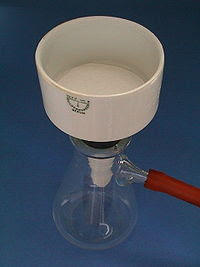 It is used in organic chemistry labs to assist in collecting recrystallized compounds. The suction allows the wet recrystallized compound to dry out such that the pure dried crystal compound is left remaining. However, it is often the case that further drying is required, by an oven or other means, in order to remove as much residual solvent as possible.
It is often used in combination with a Büchner flask, Büchner ring and sinter seals. A vacuum tight seal and stability of the Büchner flask and filter are essential during the filtration process. A Büchner ring can be used with Büchner funnels, flasks, glass crucibles and gooch crucibles. The wide flange and large surface contact ensures an excellent vacuum tight seal whilst the rings are easy to remove and offer excellent support to even the largest funnels
It is commonly thought to be named for the Nobel Laureate, Eduard Buchner, but it is actually named for the industrial chemist Ernst Büchner.
Boiling tube
00.10
 A boiling tube is a large cylindrical vessel used to strongly heat substances in the flame of a Bunsen burner. A boiling tube is essentially a scaled-up test tube, being about 50% larger in every aspect.
They are designed to be wide enough to allow substances to boil violently as opposed to a test tube which is too narrow for this task; boiling liquid can explode out of the end of test tubes when they are heated as there is no room for the bubbles of gas to escape independently of the surrounding liquid. They can also be used as a general test tube substitute particularly when a larger volume is desired. They can be used as an ignition chamber for gases where their large volume allows for a more effective gas air mixture compared to that possible in a test tube.
Boiling tubes are commonly made from Pyrex glass which can withstand high temperatures.
Aspirator
23.58
 An aspirator, also called an eductor-jet pump or filter pump, is a device that produces vacuum by means of the Venturi effect. In an aspirator, fluid (liquid or gaseous) flows through a tube which then narrows. When the tube narrows, the fluid's speed increases, and because of the Venturi effect, its pressure decreases. Vacuum is taken from this point.
 Operation
The cheap and simple water aspirator is the most common type of aspirator. It is used in chemistry and biology laboratories and consists of a tee fitting which is attached to a faucet and has a hose barb at one side. The flow of water passes through the straight portion of the tee, which has a restriction at the intersection, where the hose barb is attached. The vacuum hose should be connected to this barb.
If a liquid is used as the working fluid, the strength of the vacuum produced is limited by the vapor pressure of the liquid (for water, 3.2 kPa (32 mbar) at 25 degrees Celsius.) If a gas is used, however, this restriction does not exist. The industrial steam ejector (also called the steam jet ejector, steam aspirator, or steam jet aspirator) uses steam as a working fluid.
In order to avoid using too much steam, a single steam ejector stage is generally not used to generate vacuum below approximately 10 kPa (75 mmHg).[1] To generate higher vacuum, multiple stages are used; in a two-stage steam ejector, for example, the second stage provides vacuum for the waste steam output by the first stage. Condensers may be used between stages to reduce the load on the later stages. Steam ejectors with two, three, four, five and six stages may be used to produce vacuums down to 2.5 kPa, 300 Pa, 40 Pa, 4 Pa, and 0.4 Pa, respectively.[1]
The air ejector or venturi pump is similar to the steam ejector but uses high-pressure air as the working fluid. Multistage air ejectors can be used, but since air cannot easily be condensed at room temperature, an air ejector is usually limited to two or three stages.
BBeaker (glassware)
23.53
 A beaker is a simple container for stirring, mixing and heating liquids commonly used in many laboratories. Beakers are generally cylindrical in shape, with a flat bottom and a lip for pouring.[1] Many also have a small spout to aid pouring as shown in the picture. Beakers are available in a wide range of sizes, from one millilitre up to several litres.
Structure
Standard or "Low-form" beakers typically have a height about 1.4 times the diameter.[2] The common low form with a spout has been called the Griffin form.[3] "Tall form" beakers have a height about twice the diameter.[2] These are sometimes called Berzelius beakers.
A beaker is distinguished from a flask by having sides which are straight rather than sloping. The exception to this definition is a slightly conical sided beaker called a Phillips beaker.
Materials
Beakers are commonly made of glass (today usually borosilicate glass[2]), but can also be in metal (such as stainless steel or aluminium) or certain plastics, (notably polythene, polypropylene, PTFE). A common use for polypropylene beakers is gamma spectral analysis of liquid and solid samples.
Shape
Beakers are often graduated, that is, marked on the side with lines indicating the volume contained. For instance, a 250 mL beaker might be marked with lines to indicate 50, 100, 150, 200, and 250 mL of volume. These marks are not intended for obtaining a precise measurement of volume (a graduated cylinder would be a more appropriate instrument for such a task), but rather an estimation.
The presence of a lip means that the beaker cannot have a lid. However, when in use, beakers may be covered by a watch glass to prevent contamination or loss of the contents, but allowing venting via the spout.