ribosome
21.23
 Ribosomes are organelles that consist of RNA an proteins. They are responsible for assembling the proteins of the cell. Depending on the protein production level of a particular cell, ribosomes may number in the millions.
Distinguishing Characteristics:
Ribosomes are typically composed of two subunits: a large subunit and a small subunit. Ribosomal subunits are synthesized by the nucleolus. These two units join together when the ribosome attaches to messenger RNA to produce a protein in the cytoplasm.Location in the Cell:
There are two places that ribosomes usually exist in the cell: suspended in the cytosol and bound to the endoplasmic reticulum. These ribosomes are called free ribosomes and bound ribosomes respectively. In both cases, the ribosomes usually form aggregates called polysomes.Free ribosomes usually make proteins that will function in the cytosol, while bound ribosomes usually make proteins that are exported or included in the cell's membranes. Interestingly enough, free ribosomes and bound ribosomes are interchangeable and the cell can change their numbers according to metabolic needs.
 Ribosome structure indicating small subunit (A) and large subunit (B). Side and front view.
1 Head
2 Platform
3 Base
4 Ridge
5 Central protuberance
6 Back
7 Stalk
A tiny organelle that is the site of protein synthesis (protein translation) in the living cell. Ribosomes are complex, bead-like structures composed of about 40% protein and 60% ribosomal RNA (rRNA). In eukaryotes, ribosomes are made of four strands of RNA and are often attached to the membranes of the endoplasmic reticulum to form rough ER. In prokaryotes, they are made of three strands of RNA and occur free in the cytoplasm.
Eukaryote ribosomes are produced and assembled in the nucleolus. Three of the four strands are produced there, but one is produced outside the nucleolus and transported inside to complete the ribosome assembly. Ribosomal proteins enter the nucleolus and combine with the four strands to create the two subunits that will make up the completed ribosome. The ribosome units leave the nucleus through the nuclear pores and unite once in the cytoplasm. Some ribosomes will remain free-floating in the cytoplasm, creating proteins for the cell's use. Others will attach to the endoplasmic reticulum and produce the proteins that will be "exported" from the cell.
Protein synthesis requires the assistance of two other RNA molecules. Messenger RNA (mRNA) provides instructions from the cellular DNA for building a specific protein. Transfer RNA (tRNA) brings the protein building blocks, amino acids, to the ribosome. Once the protein backbone amino acids are polymerized, the ribosome releases the protein and it is transported to the Golgi apparatus. There, the proteins are completed and released inside or outside the cell. For more details of the role played by ribosomes in protein synthesis, see protein translation.
Mitochondria
21.11
Mitochondria are the cell's power producers. They convert energy into forms that are usable by the cell. They are the sites of cellular respiration which ultimately generates fuel for the cell's activities.

What are their distinguishing characteristics?
Mitochondria are bounded by a double membrane. Each of these membranes is a phospholipid bilayer with embedded proteins. The outermost membrane is smooth while the inner membrane has many folds. These folds are called cristae. The folds enhance the "productivity" of cellular respiration by increasing the available surface area.

Muscle Cell Mitochondria, Copyright Dennis Kunkel.
The double membranes divide the mitochondrion into two distinct parts: the intermembrane space and the mitochondrial matrix. The intermembrane space is the narrow part between the two membranes while the mitochondrial matrix is the part enclosed by the innermost membrane. Several of the steps in cellular respiration occur in the matrix due to its high concentration of enzymes.

Mitochondrion with matrix, Image courtesy of The Virtual Cell.
Mitochondria are semiautonomous (semi- auto-) in that they can divide and grow to make more of themselves. They also have their own DNA and ribosomes.
Share your opinions
The Nucleus
21.03
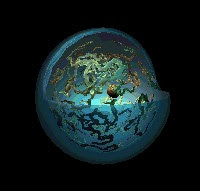 The nucleus is a membrane bound structure that contains the cell's hereditary information and controls the cell's growth and reproduction.
It is commonly the most prominent organelle in the cell.
Distinguishing Characteristics:
The nucleus is bounded by a double membrane called the nuclear envelope. This membrane separates the contents of the nucleus from the cytoplasm.The envelope helps to maintain the shape of the nucleus and assists in regulating the flow of molecules into and out of the nucleus through nuclear pores.
Chromosomes are also located in the nucleus.
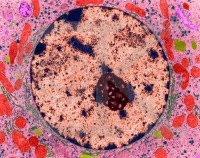 When a cell is "resting" i.e. not dividing, the chromosomes are organized into long entangled structures called chromatin and not into individual chromosomes as we typically think of them.
The Nucleolus:
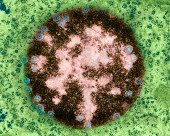 The nucleus also contains the nucleolus which helps to synthesize ribosomes.
The nucleolus contains nucleolar organizers which are parts of chromosomes with the genes for ribosome synthesis on them. Copious amounts of RNA and proteins can be found in the nucleolus as well.
The nucleus controls the synthesis of proteins in the cytoplasm through the use of messenger RNA. Messenger RNA is produced in the nucleolus of the cell and travels to the cytoplasm through the pores of the nuclear envelope.