Drosera - the Sundews
19.33
 TRAP TYPE: Flypaper Trap
Currently Ca. 152 listed species occupying temperate and tropical habitats throughout the world.
The master of sticky fly paper, Drosera (sundew), is a slow trap compared to the one in Venus Flytrap. However, the sundew relies on first trapping its prey with its sticky, glandular hairs, as shown in Figure 1, before it slowly rolls up the edges of the leaf. It does not fold like the Venus fly trap, but it can effective enclose small flies with the numerous hairs.
The sundews, so named because their glandular leaf hairs glisten like dew in the sun, are not only common in bogs, but can occur on sandy banks and other mineral soils poor in organic nitrogen and phosphorus. So fascinating is this tiny plant that Darwin (1875) spent 285 pages of his book on insectivorous plants describing his own experiments on it.
 TRAP TYPE: Flypaper Trap
Currently Ca. 152 listed species occupying temperate and tropical habitats throughout the world.
The master of sticky fly paper, Drosera (sundew), is a slow trap compared to the one in Venus Flytrap. However, the sundew relies on first trapping its prey with its sticky, glandular hairs, as shown in Figure 1, before it slowly rolls up the edges of the leaf. It does not fold like the Venus fly trap, but it can effective enclose small flies with the numerous hairs.
The sundews, so named because their glandular leaf hairs glisten like dew in the sun, are not only common in bogs, but can occur on sandy banks and other mineral soils poor in organic nitrogen and phosphorus. So fascinating is this tiny plant that Darwin (1875) spent 285 pages of his book on insectivorous plants describing his own experiments on it.


 Ca. 152 Listed Species
D. acaulis Linné (1781) | D. adelae F. Muell. (1864) | D. admirabilis Debbert (1987) | D. afra Debbert (2002) | D. alba Phillips (1913) | D. aliciae R. Hamet (1905) | D. androsacea Diels (1904) | D. anglica Huds. (1778) | D. arcturi Hook. (1834) | D. arenicola Steyerm. (1952) | D. ascendens St. Hil. (1824) | D. barbigera Planch. (1848) | D. bequaertii Taton (1945) | D. bicolor Lowrie & Carlquist (1992) | D. binata Labill. (1804) | D. brevicornis Lowrie (1996) | D. brevifolia Pursh. (1814) | D. broomensis Lowrie (1996) | D. browniana Lowrie & N. Marchant (1992) | D. bulbigena Morr. (1903) | D. burkeana Planch. (1848) | D. burmanni Vahl (1794) | D. caduca Lowrie (1996) | D. callistos N. Marchant & Lowrie (1992) | D. camporupestris Rivadavia (2003) | D. capensis L. (1753) | D. capillaris Poir. (1804) | D. cendeensis Tamayo & Croizat (1949) | D. chrysolepis Taub. (1893) | D. cistiflora L. (1760) | D. citrina Lowrie & Carlquist (1992) | D. closterostigma N. Marchant & Lowrie (1992) | D. communis St. Hil. (1824) | D. compacta Exell & Laundon (1955) | D. cuneifolia L. f. (1781) | D. curviscapa Salt. (1939) | D. darwinensis Lowrie (1996) | D. derbyensis Lowrie (1996) | D. dichrosepala Turczaninov (1854) | D. dielsiana Exell. & Laundon (1956) | D. dilatatopetiolaris K. Kondo (1984) | D. echinoblastus N. Marchant & Lowrie (1992) | D. elongata Exell & Laundon (1955) | D. eneabba N. Marchant & Lowrie (1992) | D. enodes N. Marchant & Lowrie (1992) | D. ericksoniae N. Marchant & Lowrie (1992) | D. erythrogyne N. Marchant & Lowrie (1992) | D. esmeraldae (Steyerm.) Maguire & Wurdack. (1957) | D. esterhuyseniae (Salt.) Debbert (1991) | D. falconeri K. Kondo & P. Tsang (1984) | D. felix Steyerm. & L. B. Smith (1974) | D. fimbriata De Buhr (1975) | D. fulva Planch (1848) | D.  gigantea Lindl. (1839) | D. glanduligera Lehm. (1844) | D. graminifolia St. Hil. (1824) | D. graniticola N. Marchant (1982) | D. grantsaui F. Rivadavia (2003) | D. graomogolensis T. Silva (1997) | D. grievei Lowrie & N. Marchant (1992) | D. hamiltonii C. R. P. Andrews (1903) | D. hartmeyerorum Schlauer (2001) | D. helodes N. Marchant & Lowrie (1992) | D. heterophylla Lindl. (1839) | D. hilaris Cham. & Schlecht. (1826) | D. hirtella St. Hil. (1824) | D. hirticalyx R. Duno & Culham (1995) | D. huegelii Endl. (1837) | D. humbertii Exell. & Laundon (1956) | D. humilis (Planch.) (1848) | D. hyperostigma N. Marchant & Lowrie (1992) | D. indica L. (1753) | D. insolita Taton (1945) | D. intermedia Hayne (1800) | D. intricata Planch. (1848) | D. kaieteurensis Brumm.-Ding. (1955) | D. katangensis Taton (1945) | D. kenneallyi Lowrie (1996) | D. lanata K. Kondo (1984) | D. lasiantha Lowrie & Carlquist (1992) | D. leioblastus N. Marchant & Lowrie (1992) | D. leucoblasta Benth. (1864) | D. linearis Goldie (1822) | D. longiscapa Debbert (2002) | D. lowriei N. Marchant (1992) | D. macrophylla Lindl. (1939) | D. madagascariensis DC. (1824) | D. mannii Cheek (1990) | D. meristocaulis Maguire & Wurdack (1957) | D. microphylla Endl. (1837) | D. microscapa Debbert (1991) | D. miniata Diels (1904) | D. moaensis C. Panfet (1991) | D. modesta Diels (1904) | D. montana St. Hil. (1824) | D. monticola (Lowrie & N. Marchant) Lowrie (1992) | D. moorei (Diels) Lowrie (1999) | D. myriantha Planch. (1848) | D. natalensis Diels (1906) | D. neesii Lehm. (1844) | D. neocaledonica R. Hamet (1906) | D. nidiformis Debbert (1991) | D. nitidula Planch. (1848) | D. nivea Lowrie & Carlquist (1992) | D. oblanceolata Y. Z. Ruan (1981) | D. orbiculata N. Marchant & Lowrie (1992) | D. ordensis Lowrie (1994) | D. oreopodion N. Marchant & Lowrie (1992) | D. pallida Lindl. (1839) | D. paradoxa Lowrie (1997) | D. parvula Planch. (1848) | D. pedicellaris Lowrie (2002) | D. peltata Thunb. (1797) | D. peruensis T. Silva & M. D. Correa (1982) | D. pilosa Exell. & Laundon (1956) | D. platypoda Turczaninows (1854) | D. platystigma Lehm. (1844) | D. praefolia J. G. O. Tepper (1892) | D. prolifera C. T. White (1940) | D. prostratoscaposa Lowrie & Carlquist (1990) | D. pulchella Lehm. (1844) | D. purpurascens Schlotthauber (1956) | D. pycnoblasta Diels (1904) | D. pygmaea DC. (1824) | D. radicans N. Marchant (1982) | D. ramellosa Lehm. (1844) | D. rechingeri Strid (1987) | D. regia Stephens (1926) | D. roseana N. Marchant & Lowrie (1992) | D. rosulata Lehm. (1844) | D. rubrifolia Debbert (2002) | D. salina N. Marchant & Lowrie (1992) | D. sargentii Lowrie & N. Marchant (1992) | D. schizandra Diels (1906) | D. scorpioides Planch. (1848) | D. sessilifolia St. Hil. (1824) | D. sewelliae Diels (1904) | D. silvicola Lowrie & Carlquist (1992) | D. slackii Cheek (1987) | D. spilos N. Marchant & Lowrie (1992) | D. stelliflora Lowrie & Carlquist (1992) | D. stenopetala Hook. f. (1853) | D. stolonifera Endl. (1837) | D. subtilis N. Marchant (1982) | D. sulphurea Lehm. (1847) | D. tentaculata Rivadavia (2003) | D. tomentosa St. Hil. (1824) | D. trinervia Sprengel (1820) | D. tubaestylis N. Marchant & Lowrie (1992) | D. uniflora Willd. (1809) | D. venusta Debbert (1987) | D. villosa St. Hil. (1824) | D. viridis Rivadavia (2003) | D. walyunga N. Marchant & Lowrie (1992) | D. whittakeri Planch. (1848) | D. yutajensis R. Duno & Culham (1995) | D. zeyheri Salter (1940) | D. zigzagia A. Lowrie (1999) | D. zonaria Planch. (1848)
Dionaea muscipula - The Venus Flytrap
19.19

One species, Dionaea muscipula J.Ellis (1768), occupying habitats in the southeastern United States of America (North Carolina, South Carolina).
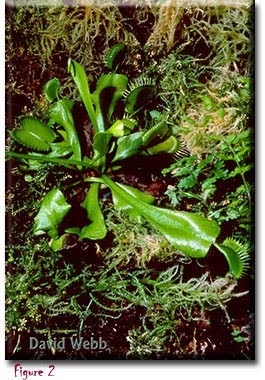
The steel trap of Dionaea is hardly as powerful as the ones set by trappers for wolves, beavers or bears, but it is just as effective at catching its own small prey. Figure 1 shows the traps ready to spring. Its growth in the wild is restricted to the bogs in the central southeastern coastal plain of the United States. Figure 2 below is a Venus flytrap in its natural environment.
Near the crease where the two leaf "jaws" join there is a series of tiny hairs. If an unwary insect walks across these hairs, touching two or more of them in succession, the leaf will close quickly enough to prevent its escape. Unable to escape between the hair-like teeth at the edge of the leaf (Figure 3), the helpless insect is slowly digested and absorbed by the leaf. Glands on the leaf surface secrete several digestive enzymes that help to decompose the insect. Once the insect has been digested sufficiently, the leaf re-opens for another victim.
 The sensitive hairs at the fold of the leaf prevent the leaf from closing every time a drop of rain lands on it, because the leaf requires that two or more of these hairs be triggered in succession (Figure 3). If the leaf does close without a victim, it will re-open in a few hours. According to Lloyd (in George 1962), the traps can only catch about three victims before the leaves turn black and die. And even if the trap fails to catch anything, like when you tease it by touching a hair with a small brush, it can only reopen and close again about seven times! So, don't tease the flytrap!
The mechanism of closing has fascinated biologists for many years. How can an inanimate plant react so quickly to the stimulus of touch? The most widely accepted explanation had been that a rapid change in the turgidity of the cells occurs. That is, there must be a sudden change in the water pressure in the cells – the cells of the bottom part of the midrib, that is. Now we know that it is not nearly so simple, nor is our old explanation valid, although the lower midrib cells do indeed take in more water. In Dionaea, the closing occurs in as little as a half second. Salisbury and Ross (1985) explain the phenomenon as acid growth.
 Early theories on the acid growth suggested that potassium or sodium must rush into the lower midrib cells to create an osmotic gradient. That means there is more salt inside than outside the midrib cells, and more water outside those cells than inside. However, Hodick and Sievers (1989) provided evidence that a change in turgor pressure due to movement of potassium or sodium was not the cause, but they were unable to provide any evidence to support an alternative theory.
 Nevertheless, we now we have a somewhat clearer picture, but it still is only a collection of circumstantial evidence without direct links to demonstrate cause and effect. First the hairs are triggered, two in succession, and these triggers set up a change in the electrical potential, sending a signal to the lower cells of the midrib. Then a flurry of things happen so fast that we don't know what happens first. The growth hormone IAA appears in the midrib in increased concentrations. Hydrogen ions move rapidly into the cell walls of the midrib in response to action potentials from the trigger hairs (Salisbury and Ross (1985)).
We can only guess what happens here, but a good guess would be that a proton (H+) pump moves H+ ions out of the midrib cells and into the cell wall spaces between the cells. (Cell walls are really lots of fibers hooked together, creating a network of small capillary spaces.) Hydrogen ions naturally make this area more acid. These hydrogen ions seemingly loosen the cell walls, probably by dissolving the calcium pectate that glues the cellulose together, causing the tissues of the lower side of the midrib to be come flaccid. Calcium (not potassium or sodium as thought earlier) increases inside the cells and the cells absorb water.
 It seems reasonable that this calcium might move into the cells by following the charge gradient. After all, if H+ ions left, the cell now has negative charges (electrons) that have no positive partner; the cell has a negative charge. This negative charge will attract positively charged things (positive ions, or cations) from outside the cell, like the Ca++ (calcium ions) that were freed from the calcium pectate bonds of the cellulose fibers. Once the calcium enters the cell, it creates an osmotic gradient. There is now a greater proportion of Ca++ and smaller proportion of water (H2O) on the inside of the cells than on the outside of the cells in the cell wall spaces. The result? Water enters the cells by osmosis. Since the cells have become unglued, they are able to expand as they take in water, and hence they grow.
This results in the expansion of the outside of the leaf and the "springing" of the trap. Yes, all this happens at lightning fast speed to make the leaf close. The cells remain at this larger size and the cellulose eventually increases to strengthen the walls. That gets the trap closed, but in a few days, it must re-open. Once the insect is digested, the cells on the upper surface of the midrib will grow, much more slowly, and the leaf will re-open.
 As you might imagine, the leaf cannot keep doing this rapid growth trick forever. That is why it is only able to close its trap about seven times during the life of a leaf. But why does it do this at all? In its boggy peatmoss habitat, nutrients are very limited. It can't use the nitrogen in the atmosphere (neither can we!), but it does need some form of nitrogen. Experiments on the Venus flytrap by Roberts and Oosting (1958) suggest that perhaps it is the organic form of nitrogen and phosphorus that is important to the insectivorous plants. And the trapped insects give them just that.
 The Venus Flytrap is one of the easiest carnivorous plants to grow. If you wish to grow one or more, they have only a few requirements such as, wet roots, high humidity, full sunlight, and poor, acidic soil. It comes shipped to you as a bulb or rhizome. Plant it root side down so that the top of the bulb is even with the soil. A recommended soil mixture is one that contains sphagnum moss and sand. Do not add fertilizer or lime. Your plants will do better if you transplant them into new soil every few years.
In order to provide high humidity for your Venus Flytrap, plant it in a terrarium or in a glass container with a small opening. An old aquarium or fish bowl makes a good container for this purpose. You need to watch your terrarium in the summer because the temperature inside the glass may get too hot. Two hours in the sun may be sufficient. If your plants wilt, then they need to come out of the sun sooner. Just the opposite is true for winter. If it gets very cold in your area you may need to move your plants away from the window or cover them at night in order to keep them warm and moist. However, your Venus' Flytrap will experience a dormant period in the winter, from Thanksgiving to Valentine's Day so it needs fewer hours of daylight and cooler temperatures.
 Another way is to plant it in a pot and place the pot in a larger container such as a bucket. Partially cover the top of the bucket with a piece of glass or Plexiglas. Don't cover the entire top because air needs to circulate.
After your plant matures, it may produce flowers on a tall stalk far above the leaves. It has to be high above the leaves so insects pollinating the flowers do not get trapped in the leaves. Each flower produces very tiny seeds. They are about the size of the period at the end of this sentence. Plant the seeds right away or store them in the refrigerator. If you pinch the flowers off, the leaves will grow more vigorously since growing flowers takes a lot of energy from the plant.
The Venus' Flytrap also reproduces via its rhizome. It never has more than seven leaves. If your plant has more then seven leaves, it has already split off another plant from the mother plant. You may want to try pulling a leaf off and replanting it. Eventually, this leaf will die off and a tiny, tiny new plant will emerge.
If you wish to obtain and grow Venus' Flytraps you may check to see if you have a local greenhouse that carries them.
If you grow your plant outside, it will get enough insects to eat. If it rains the container may fill up with water but this will not hurt the plants, they can live underwater for months. If you grow your plant inside you will need to feed it insects. A couple of houseflies or small slugs per month is enough during the growing season. Do your plant a favor and DO NOT feed your Venus flytrap plants hamburger! Indigestion and rot may occur and usually your plant will die. Find a "just right" sized bug instead!
INSECTIVOROUS (CARNIVOROUS) PLANT REFERENCES1. George, J. 1962. Plants that eat insects. Readers Digest Feb: 221-226.
2. Hodick, D. and Sievers, A. On the mechanism of trap closure of Venus flytrap (Dionaea muscipula Ellis). Planta 179: 32-42.
3. Salisbury, F. B. and Ross, C. W. 1985. Plant Physiology. Wadsworth Publ. Co., Belmont, Ca. 540 Pp.
4. Roberts, P. R. and Oosting, H. J. 1958. Responses of Venus fly trap (Dionaea muscipula) to factors involved in its endemism. Ecol. Monogr. 28: 193-218.
Anatomy Of Frog
04.43

a. Esophagus opening
b. Vomerine teeth
1. Grove of the maxilla
2. Maxillary teeth
3. Internal nare
4. Eye ball
5. Eustachian tube opening
6. Jaw ridge
7. Underside of the tongue
8. Glottis
9. Cut muscle and bone
Female Frog Internal Anatomy
 1. Liver lobes
2. Heart
3. Ovary with eggs
4. Gall bladder
5. Small intestine
6. Stomach
7. Oviduct
Male Frog Internal Anatomy

a. Large intestine
b. Small intestine
1. Lung lobes
2. Heart
3. Liver lobes
4. Gall bladder
5. Stomach
6. Small intestine
7. Testis
8. Fat body
9. Urinary bladder
Chain reaction
17.36

The only problem with the chain reaction is the fact that each stage of the reaction instigates more than twice as many fissions as the next stage (almost three times as many!).This results in the amount of energy produced at each stage more than doubling if the reaction is left unchecked. Each stage occurs in less than a millionth of a second therefore the heat energy produced can be phenomenal.The reaction is said to escalate. If we requirea steady energy output of energy only one neutron from each fission should be allowed to go on to make another fission reaction. The reaction needs to be controlled - see control rods.
The diagram below summarises what happens in a chain reaction. You are often asked to sketch a diagram to show chain reactions in exams - make sure you label them properly.

The atmosphere
04.27
The Earth's atmosphere is a layer of gases surrounding the planet Earth that is held in place by the pull of Earth's gravity.
The Earth's atmosphere contains a mixture of gases is commonly known as air:
- 78% nitrogen,
- 21% oxygen,
- 0.93% argon,
- 0.04% carbon dioxide - although this is increasing
- water vapour (average of 1% - but that varies).
- trace amounts of other gases
The atmosphere protects life on Earth .
- It is deep enough to absorb X-rays and gamma rays from outer space, preventing them from reaching ground level at all.
- The ozone layer absorbs ultraviolet solar radiation.
- The atmosphere acts like a blanket over the Earth, reducing temperature extremes between day and night - making it easier for life forms to survive.
The atmosphere absorbs and reflects some of the heat radiation from the Sun.
This prevents the Earth’s surface from getting too hot during the day. It retains some of that energy so that all of the energy collected from the Sun is not lost during the night (as would be the case if there was no atmosphere). Only some of it is radiated back out into space. This stops the temperature of the Earth from dropping too low during the night. It is able to do this because some of the molecules of gas in the atmosphere are ‘greenhouse gases’.
There is no definite boundary between the atmosphere and outer space. It slowly becomes thinner and fades into space. Three quarters of the atmosphere's mass is within 11 km of the planetary surface.
- People who travel above an altitude of 80.5 km (50 miles) are called astronauts.
- An altitude of 120 km (75 miles) marks the boundary where atmospheric effects become noticeable during re-entry.
- The Kármán line, at 100 km (62 miles), is also frequently regarded as the boundary between atmosphere and outer space.
 The temperature of the Earth's atmosphere varies with altitude (how high up you are!); the mathematical relationship between temperature and altitude varies among five different atmospheric layers.
The troposphere is the layer closest to the earth, and it is the layer in which we live. It is about ten miles deep. Seventy five percent of the mass of all our atmospheric molecules is in the troposphere, and this is where we find water vapour, dust, pollen, and soot particles. Weather happens in the troposphere. This layer is turbulent, with storms and atmospheric mixing.
In the troposphere, the air cools gradually as it gets further from the earth. At the very top of this layer the air temperature is about -60 oC. Water vapour is therefore in the form of ice. This forms what we call the cold trap - a temperature region where water vapour rises no further (because it has solidified). If we had no cold trap, water molecules could rise higher and higher in the atmosphere are they would eventually break down into oxygen and hydrogen at the outermost layers - the small, light hydrogen molecules could then escape into space. Earth would lose its water if we had no cold trap!